How do our smartphones, cars, home appliances, medical equipment and bank cards work? Most of the technologies we use every day are based on microelectronics. All of this functions thanks to microchips made of monocrystalline silicon. This high-quality semiconductor material has exceptional features ensuring stable and reliable operation of electronic components.
Arofel Semicor LLC, in cooperation with Prolog Semicor LLC, forms the only production complex of its kind in Ukraine that is specialised in producing monocrystalline silicon and wafers for microelectronics and solar panels. This is a complex, research-intensive and high-tech manufacturing process. The process of producing monocrystalline silicon alone takes over 30 hours, requiring a stable and uninterrupted power supply, which is particularly important given the ongoing Russian attacks on the Ukrainian power grid.
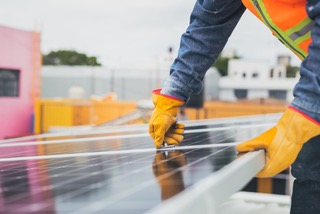
To tackle this challenge, Arofel Semicor LLC participated in the EU4Business-EBRD Credit Line and received a loan of EUR 293 thousand through one of the programme’s partners: ProCredit Bank. The company invested in a hybrid solar power station comprised of 952 modules with a capacity of 438 kW and the ability to store 600 kWh of electricity. The new equipment ensures a stable energy supply for up to three hours in the event of power cuts, and also allows storing solar energy during peak generation hours and selling any surplus at market price in the highest consumption periods. Investment costs for the project were reduced by 10% thanks to the EU grant, which is an integral part and a significant advantage of this programme.
To tackle this challenge, Arofel Semicor LLC participated in the EU4Business-EBRD Credit Line and received a loan of EUR 293 thousand through one of the programme’s partners: ProCredit Bank. The company invested in a hybrid solar power station comprised of 952 modules with a capacity of 438 kW and the ability to store 600 kWh of electricity. The new equipment ensures a stable energy supply for up to three hours in the event of power cuts, and also allows storing solar energy during peak generation hours and selling any surplus at market price in the highest consumption periods. Investment costs for the project were reduced by 10% thanks to the EU grant, which is an integral part and a significant advantage of this programme.
The EBRD and the EU help small and medium-sized businesses in Ukraine develop key production sectors and invest in green energy, thereby accelerating innovations, boosting energy independence and competitiveness.